
The Submission Last-Mile: What the Room Found
Executive Insight Report — Clinical AI Mastermind 2026, Session 1
Event
May 20, 2026
Johnson & Johnson, 320 Bent Street, Kendall Square, Cambridge, MA
Statement
When we set the question for Session 1, we made a claim before the room had tested it. We said the Last-Mile of clinical submission is no longer primarily a data problem. It is an architecture problem. The data arrives clean more often than it does not. What slows the path from clean data to submission-ready output is the way the work itself is built: the handoffs, the verification steps, the human and machine roles that were designed for an earlier era. On May 20, that claim met a room of people who live this problem every day, and they did not soften it. They sharpened it. This report is what they found.
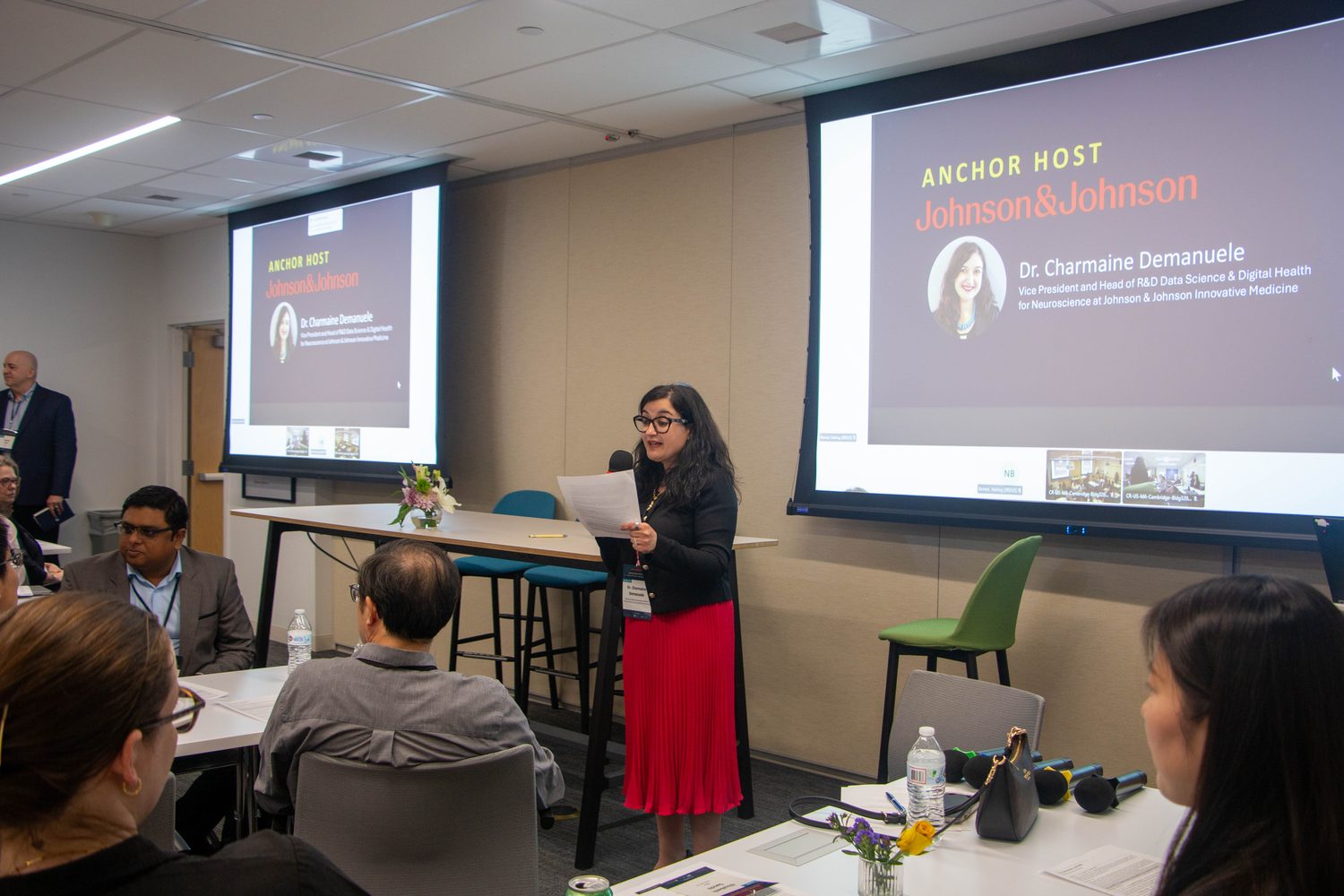
In welcoming the room, Dr. Charmaine Demanuele of Johnson & Johnson set the three lenses that framed the day. Scale, embedding AI across tools and workflows without losing quality or compliance. Agility, accelerating clinical development because time is life. And Integrity by design, building tools we can trust, reproducible systems that operate inside a regulatory environment. Whatever we develop, she reminded the room, has to make a meaningful impact for patients.
Fion Liao — Curation Team Member · Clinical AI Mastermind 2026
What the Room Said at the Door
Before the forum, every applicant was asked one question, written on the wall of the room as the seats filled:
In your experience, where does the submission Last-Mile most consistently break down, and what has your organization not yet solved?
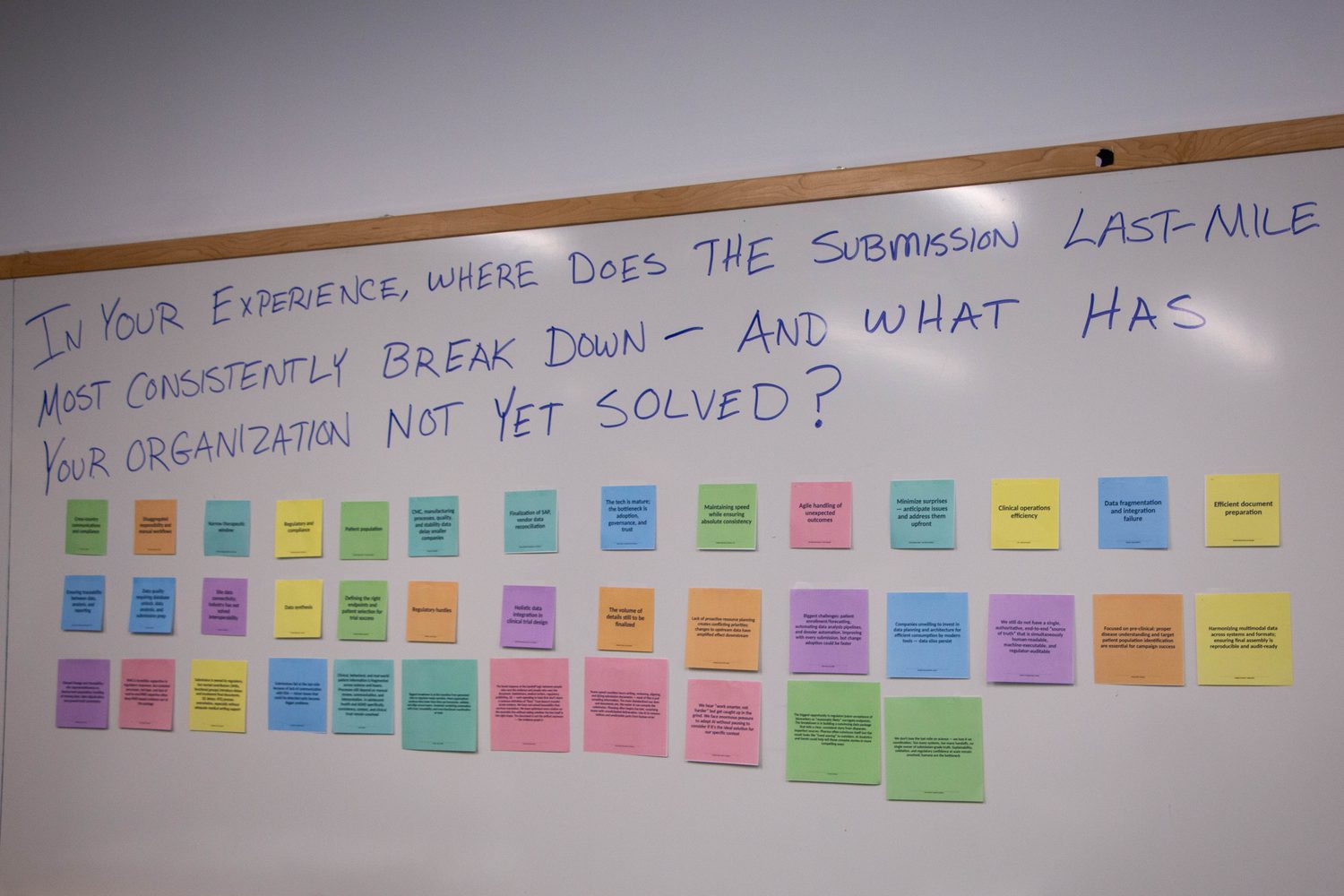
Thirty-nine answered, and every card went up on the wall. We did not offer the room the thesis. We asked where the Last-Mile breaks, and the answers, taken together, were the thesis. Almost none named the data itself. They named the architecture around it: the seams, the handoffs, the missing owner, the loss of trust as work moves from one system to the next. Eight themes emerged.
1. The handoff problem: no single owner of submission-grade truth. The most frequently raised theme. Leaders placed the breakdown not in the science but in the coordination between teams who each hold one piece of the submission. Statisticians, medical writers, regulatory, publishing, and QC each work in tools that do not share a common definition of “final.” A regulatory consultancy put it directly: the last mile is lost on coordination, not science, with too many systems, too many handoffs, and no single owner of submission-grade truth. A clinical strategy consultancy named the same thing as disaggregated responsibility and manual workflows.
The document is not the artifact anymore. The evidence graph is.
— Healthcare AI Strategist · advisory
2. Traceability that survives translation. Numbers move from tables to clinical study reports to briefing books to labels. Each step is defensible alone, but the chain of provenance frays. A healthcare AI strategist framed the deeper shift: trust does not transfer across systems, the industry has optimized every station without asking whether the assembly line is the right shape, and the document is no longer the artifact. A biotech R&D founder described what is still missing as a single, authoritative, end-to-end source of truth that is at once human-readable, machine-executable, and regulator-auditable.
3. Data fragmentation, silos, and interoperability. Data sits scattered across systems, formats, and teams, and the industry has not solved interoperability. A chief data innovation officer at a biotech pointed to companies still unwilling to invest in the data architecture that modern tools need, so silos persist. A health-tech chief executive named site data connectivity as the unsolved layer beneath everything else.
4. Trust, governance, and the AI confidence gap. Several leaders agreed the technology is largely mature and the bottleneck is human confidence in it. An academic-industry advisor put it as adoption, governance, and trust rather than capability. A regulatory consultancy noted that explainability, validation, and regulatory confidence at scale remain unsolved, which is why humans stay in the loop. A health-tech analytics manager described the pressure to adopt AI without pausing to ask whether it fits the specific context.
5. Document compilation is where the time disappears. A head of global portfolio statistics at a top-ten pharma observed that teams spend countless hours writing, reviewing, aligning, and QCing submission documents, when most of that work is simply compiling information that already exists. The bottleneck is assembly, not insight. The more standardized the data and documents, the more of that compilation a machine can carry.
6. Late planning and the surprise of unanticipated deliverables. Submission planning often starts too late, and teams are caught out by deliverables they did not expect. An R&D technology partner at a biotech described how the absence of proactive resource planning creates conflicting priorities, and how a change to upstream data has an amplified effect downstream. A rare-disease digital health lead framed the goal simply: minimize surprises by anticipating issues and addressing them upfront.
7. Building a convincing narrative from imperfect data. Pharma can generate data faster than it can harmonize and align it into a regulator-ready story. A senior neuroscience director at a top-ten pharma described the breakdown as building a convincing package from disparate, imperfect sources, where a team can convince itself while the result still reads as hand-waving to an outside reviewer. An academic-medicine instructor placed the same break at the transition from generated data to regulator-ready narrative.
8. Communication with the regulator. One voice pointed outward rather than inward. A regulatory-law partner observed that submissions often fail at the last mile for lack of early dialogue with the FDA, where minor issues that could have been caught early grow into larger ones by the end.
Taken together, the room’s written diagnosis pointed in one direction before a single keynote began. The Last-Mile breaks at the architecture, not the data. The three lenses that followed were the room’s answer to its own question. The full set of responses appears in the appendix.
What the Three Lenses Revealed
The room had named where the Last-Mile breaks. The forum answered through three lenses. As Dr. Alexandre Duprey of Hill Research put it in his opening remarks, the paradox is that data is plentiful and analyses are plentiful, and the limitation now is operationalization. The three lenses are three ways into that one problem.
They were not chosen for symmetry. Scale is the view from the large enterprise, where the Last-Mile means embedding AI across global tools and workflows without losing quality or compliance. Agility is the view from the AI-native builder, where speed matters because, as the moderator put it, time is life, and in neuroscience time is brain. Integrity is the view that sits across both, building tools an organization can trust, reproducible systems that operate inside a regulatory environment. These are the three vantage points the Mastermind returns to across all four sessions of 2026.
On the day, Scale and Integrity were delivered as keynotes. Agility was carried into the panel by Dr. Bhaskar Dutta, who stepped in on short notice when Dr. Stuart Bailey could not be present. Read together, the three made the same move from three directions, each treating the bottleneck as a question of how the work is built, not how much data is available.
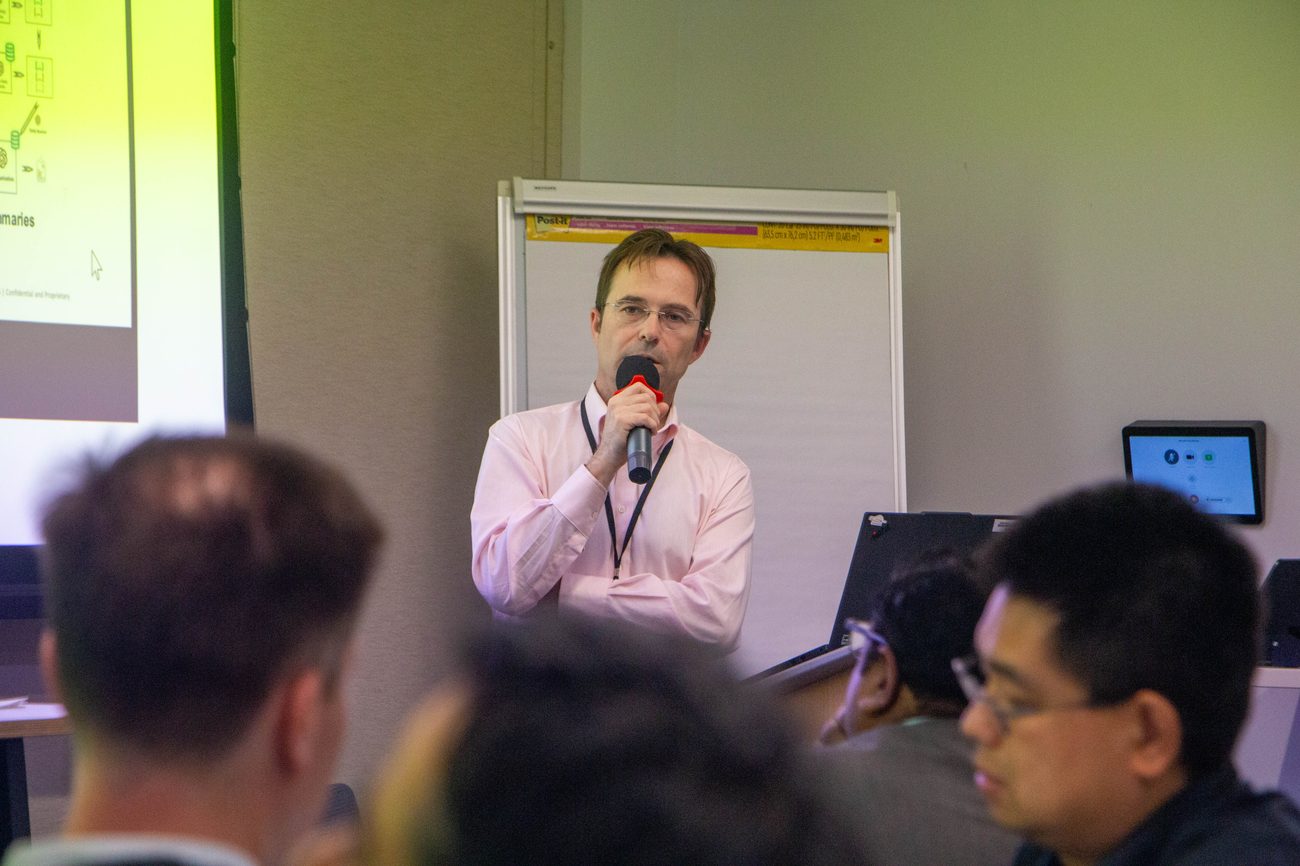
Scale — Dr. Rogier Landman · Pfizer
Rogier set the Scale lens at the very end of the pipeline, on the documents that have to reach the FDA, and on one in particular: the Statistical Analysis Plan, which tells programmers how every analysis will be done. He showed an agentic SAP Automator already in use, built on vector and knowledge-graph databases and orchestrated with a large language model to turn a protocol into a first-draft SAP. The numbers framed the stakes. A SAP takes roughly 14 to 28 days to write, Pfizer produces around 200 a year, and the target was to roughly halve the drafting time. The system ingests the protocol, the internal template, and prior SAPs, and returns a Word draft populated section by section, with two gains beyond speed: greater standardization, and through that, better quality.
Two points from this talk matter for everything that followed. The first is trust through transparency. Rogier’s team published its method and evaluation in the journal Clinical Trials, under the title “Leveraging generative AI to transform statistical analysis plan authoring in clinical trials,” and his argument was that moving from a black box toward a documented, benchmarked, human-in-the-loop system is what earns trust. He also built that transparency into the artifact itself, delineating which passages are copied verbatim from the protocol and which are AI-generated, so a reviewer knows exactly where to look. The second point is the role shift. The statistician still signs the document, but the work moves from drafting toward reviewing what the machine produced. Time is saved overall, and the shape of the work changes. That shift was the quiet center of the keynote, and arguably its most lasting insight.
Rogier ended not with a conclusion but with a question to the room, asking which one document or workflow each organization would rebuild first, and why. It was the architecture thesis turned back on the audience, and it set the panel in motion.
Agility — Dr. Bhaskar Dutta · Alexion
Agility reached the room through the panel rather than a keynote. Bhaskar’s core claim previews the deeper discussion on the next page: the tools can already move quickly, but the operating model around them was never built for that pace. Agility, in his account, is an operating-model question before it is a technology question. The panel section takes this further, through the two dimensions of the bottleneck and the FDA’s real-time pilot.
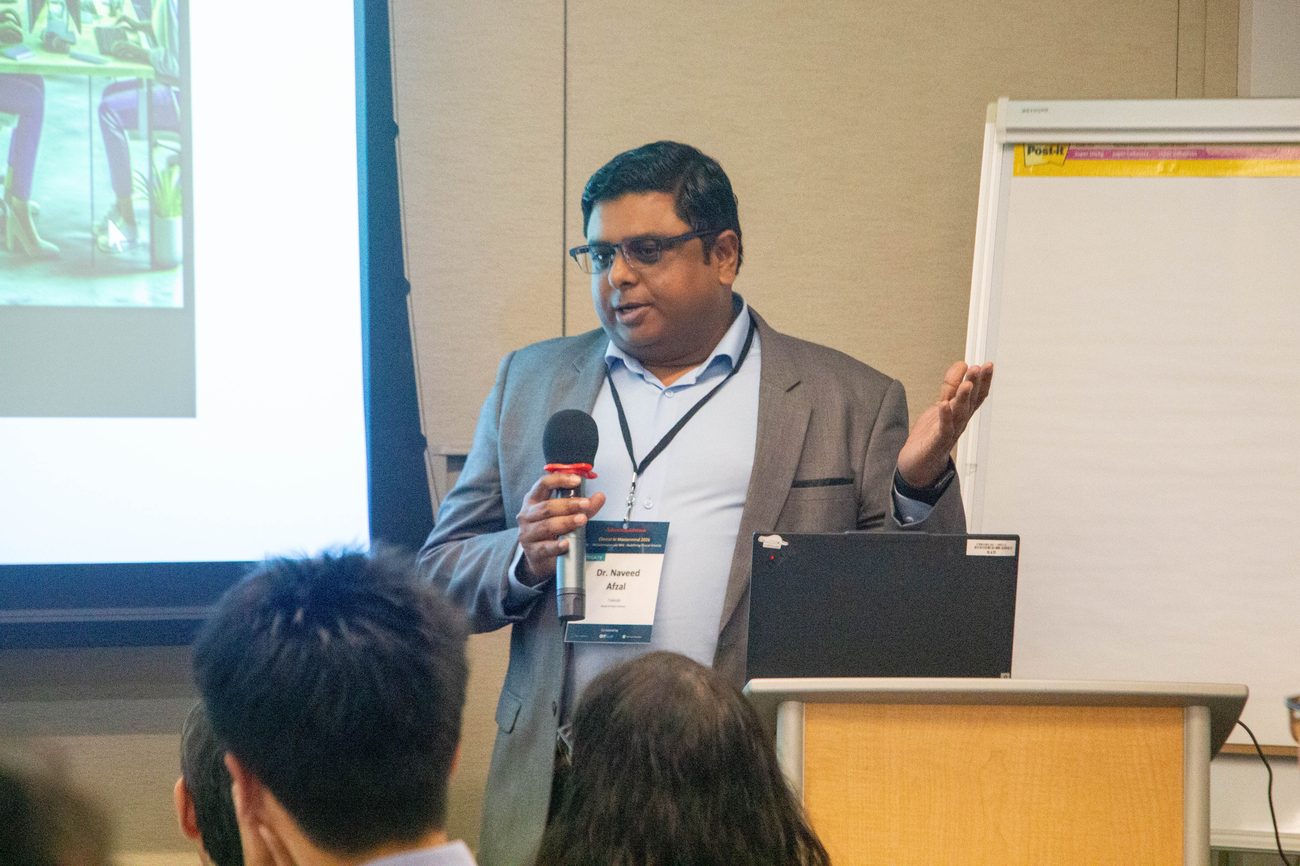
Integrity — Dr. Naveed Afzal · Takeda
Naveed opened with a reframing: integrity is not what slows AI down, it is what makes speed defensible. Auditability and velocity, he argued, are the same ambition designed over time, and in the Last-Mile the problem is not a data problem but an architecture problem, with integrity built into the system. He named the trap directly. Agility teams optimize for fast iteration and quick signals, and integrity arrives later as documentation requests and governance reviews, so it gets mistaken for a compliance tax while AI velocity turns fragile. The real issue, he said, is not whether a model performs well once, but whether you can prove how that performance was achieved. When integrity is retroactive, validation becomes manual, reviewers are forced into detective work, institutional memory is lost as teams rotate, and the organization feels slow even when its models are fast. He pointed to a finding that most CFOs see their digital and AI spending underperforming, and traced the common cause to integrity that was never designed in.
From there he set out three architectural principles: treat provenance as first-class, so data, labels, features, code, and parameters are tracked by default; value reproducibility over explanation, so outputs can be regenerated and not merely described; and embed controls, so validation, bias checks, and drift monitoring run inside the pipeline rather than at a final gate. The reframing that anchored it was to stop treating AI outputs as insights and start treating them as evidence objects, assembled continuously from model version, data snapshots, transformation logic, validation results, and human overrides. An organization built this way operates audit-ready rather than preparing for the audit. Integrity, in his closing phrase, converts experimentation into enterprise capability, and the first organizations to design for it will move faster with more regulator confidence, not less.
The three lenses pointed at one word in common, and the panel returned to it again and again: trust. The discussion that followed carried each lens into the open.
In-Depth Discussion of the Three Pillars
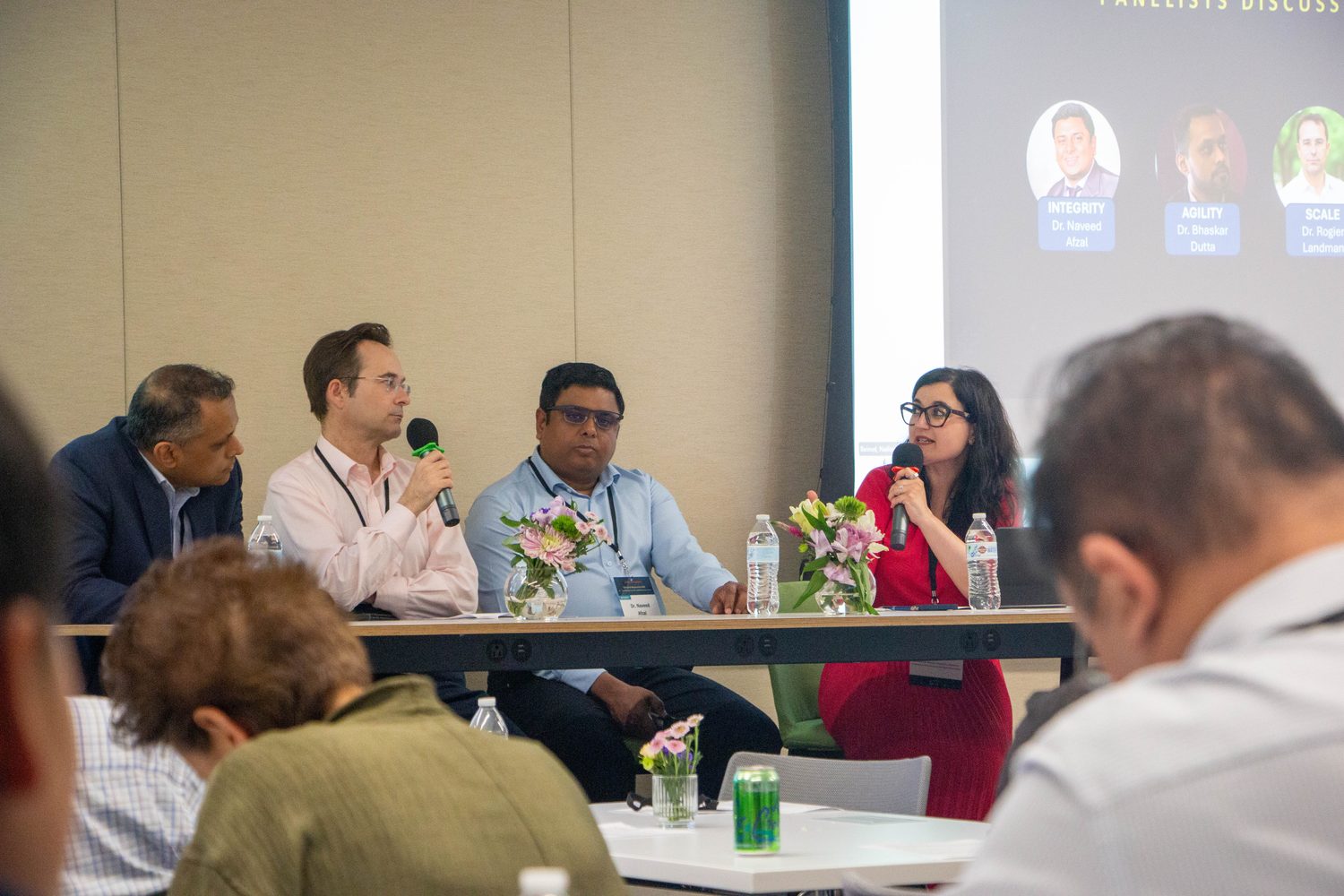
After the keynotes, Dr. Charmaine Demanuele brought the three speakers into a moderated panel and took each lens into the open. What emerged was not three separate conversations but one, circling a single word the room kept returning to: trust.
Scale · the barrier is the operating model, and the currency is trust
Charmaine opened the Scale question by routing it first through the Integrity seat, asking Naveed what most blocks scaling AI across the enterprise, whether technology, data, or something else. His answer was unambiguous: it is the operating model. Put the right controls in place and the work becomes repeatable; without them, every project reinvents itself. Asked what those controls actually are, he named six.
- Lineage, of data and transformations
- Versioning, of both model and data
- Audit workflow, recording who did what, when, and with whose approval
- Monitoring, for bias, anomalies, and drift
- Decision workflow, how decisions are made and overridden
- Accountability, who is responsible at each handoff
Rogier then came back from the Scale seat and grounded the controls in his own case. Lineage, versioning, and an audit trail, he noted, are precisely what let a tool move from drafting one Statistical Analysis Plan to supporting roughly two hundred a year without each one being rebuilt by hand; the operating model is what turns a working pilot into a repeatable capability. He returned to the mechanisms from his keynote that make that scale trustworthy. One is publishing the method and its evaluation, so the system is benchmarked in the open rather than taken on faith. The other is a practical trust mechanic at the level of the artifact itself: in SAP generation, some text is copied verbatim from the protocol and some is AI-generated, and the system delineates which is which, so a user knows exactly which sections need scrutiny. And he came back to the role shift that scale forces, the statistician still signs the plan, but the work moves from drafting toward reviewing what the machine produced.
If Naveed supplied the architecture and Rogier the working example, Bhaskar supplied the human reason it matters, and reduced it to a single word: trust. He asked the room to stand in the shoes of a clinical program leader who has given three or four years to a program that may be the best work of a career and the company’s next major investment, and then to decide whether to experiment with an unproven AI tool on it. The honest answer is often no. What changes that answer is earning trust first, and his two mechanisms were concrete. Peer-reviewed publication of methods signals that a tool has passed external rigor rather than internal politics. And once one program adopts it and sees value, adoption becomes a pull rather than a push. In his words, you will not have to go to them; they will come to you.
Charmaine placed this in historical context. The pattern is the one the field already lived through with digital endpoints, which were once dismissed as useful but not for my trial, until regulators pushed, value accumulated, and the culture shifted. Every new technology, she noted, needs a culture change and not only a technical one, and the room felt the three lenses converge on that single point.
Agility · the bottleneck is the operating model too, and the FDA is about to move it
Turning to speed, with the reminder that what matters is the impact on patients, Charmaine asked Bhaskar where the real bottleneck to velocity sits. He described two dimensions. The first is human and therapeutic-area specific: a large pharma spans many diseases and programs, each with different needs and appetites, so a single tool rarely fits cleanly across all of them, and human practice, not only human factors, has to be customized to each setting. The second is the long action cycle inside a large organization, from asking whether a problem even suits AI, through aligning stakeholders, running a pilot, proving the pilot worked, and only then scaling.
Naveed sharpened the data side. The issue is not data availability but data usability, the right quality, the right lineage, the right governance. He urged care with the hype, recalling an early claim that AI would replace radiologists that looked spectacular under narrow conditions but did not hold in practice, and his rule was that generative and agentic AI perform only within a clearly defined scope, with clear guardrails and policy.
Charmaine then pointed to the operating-model shift now arriving from the regulator. The FDA has launched a real-time clinical trials initiative in which sponsors and the agency exchange real-time signals rather than patient-level data, aimed mostly at early-phase trials. Getting ready means designing protocols with real-time signals in mind, generating clean data at the source, moving from episodic to continuous monitoring, and building systems ready for real-time visibility with integrity as a core component. Her framing was the heart of it: this is not really a policy change, it is a change in operating model, in how we think about running clinical trials. Bhaskar argued the shift is good for everyone, giving sponsors earlier go and no-go decisions, exposing fewer patients to trials that are not working, and giving the FDA earlier visibility. His reading of what the agency actually wants was specific: aggregate-level information rather than patient-level data, and not rocket science but a change in operating model, getting real-time signals agreed early rather than waiting for database lock.
Crystal ball · what the Last-Mile looks like in 12 to 18 months
Charmaine closed the panel by asking each speaker for a hypothesis on the Last-Mile architecture 12 to 18 months out. Naveed was deliberately contrarian. Many data and AI leaders at the executive table today have never been hands-on practitioners, he argued, and their second-hand knowledge is a liability when the pace of change is this fast, because every polished vendor demonstration will look attractive and few will integrate into the long-term workflow. Seeing which ones fit is precisely the executive’s job. Bhaskar offered the most expansive picture: end-to-end agentic solutions running from protocol to SAP to analysis to tables to clinical study report to a submission-ready package, where the agentic layer means the exploratory step is done once and not repeated every time. Charmaine’s reply was the honest one, that achieving all of it inside 18 months is the real challenge. Rogier’s contribution to the round was the steadying counterpoint, the one Charmaine drew out in her close: even if the artifact changes, even if the clinical study report itself fades, the durable win is the evaluation capability built along the way. His SAP and CSR work had produced benchmarks to judge AI output back in 2023, when benchmarking was barely established, and that capability outlasts any single document. Success, on this reading, is partly what the work teaches us, better protocols, better reports, better ways to evaluate AI. The disagreement and the convergence together handed the inquiry to the room.
The questions the room asked
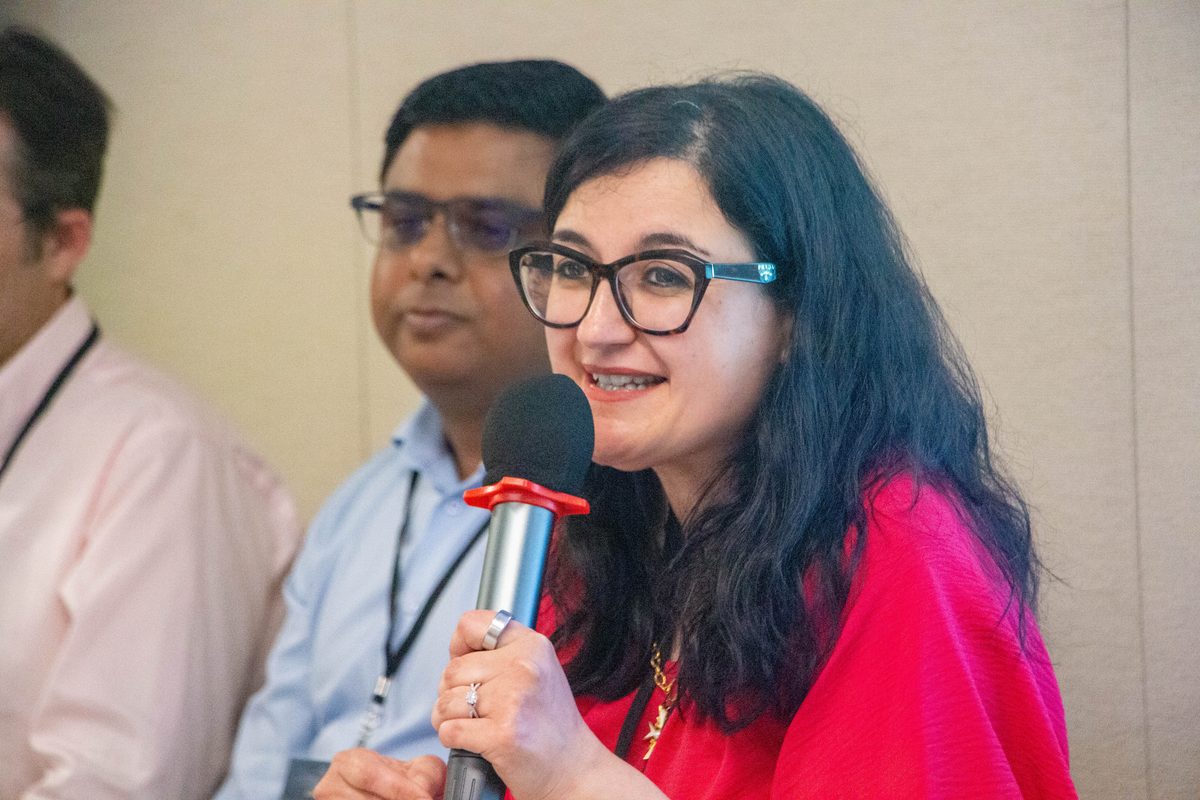
This forum is co-shaped with its attendees, and the open exchange was where the deepest questions of the day emerged. Six are worth preserving, because they seed the sessions still to come.
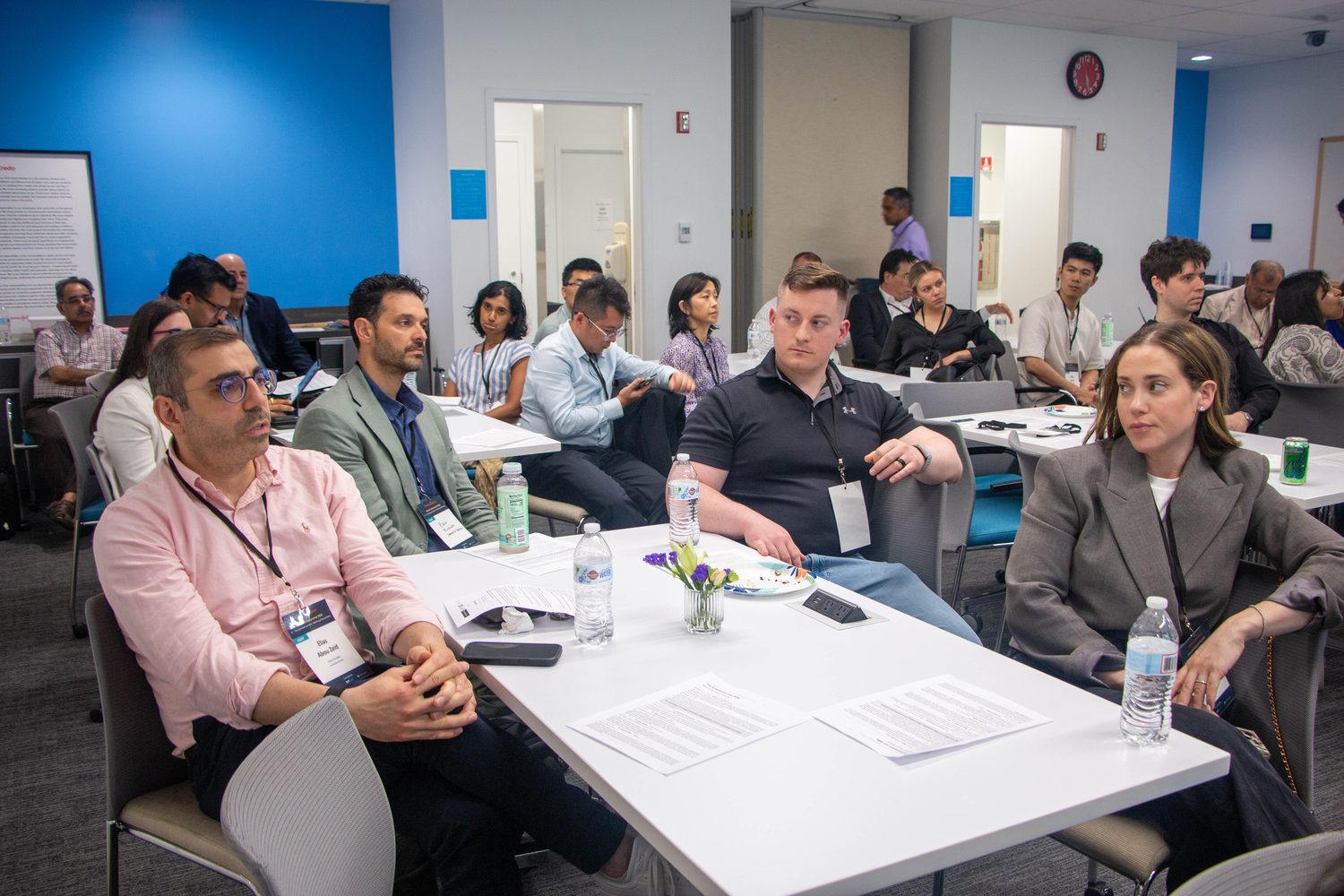
On customization versus general models, an attendee asked whether a generic, LLM-driven tool can really handle science where every study is different. The panel was aligned: the goal is not a human-out-of-the-loop system but a structured skeleton to start from, with domain expertise still essential, and AI used for the parts it is good at rather than the whole. Charmaine added that the advantage is not only speed but the chance to ask different questions of the data and find what was not known before.
On whether the limit is the technology or the organization, an attendee asked how much of the integrity challenge is poor system design versus the inherent limits of today’s AI, and why standardization across companies still feels ad hoc. Naveed located the real blocker in mindset, the habit of experimenting first and bolting validation on at the end rather than building governance through the workflow. Charmaine returned to context of use, that a system validated for one context does not automatically generalize, so the context should be specified up front and trust follows from that.
On the QC and audit step, an attendee noted that as upstream drafting gets solved, the bottleneck moves downstream to error identification and audit, and asked whether AI suits that role too. Rogier said many issues can already be caught by AI as well as by a person, shrinking the human checklist while leaving a residue that needs judgment. Bhaskar went further, calling QC one of the best current uses of AI, with multiple agents cross-checking each other before a human ever sees the work.
On the artifact itself, an attendee asked whether the clinical study report is even the right thing to optimize, given that the FDA increasingly runs its own AI on submission data, a future of data objects supported by narratives rather than narratives supported by data, AI talking to AI. Naveed’s answer was context intelligence, illustrated by managing more than a hundred thousand data sources at Takeda through domain classification, an LLM-as-judge layer with confidence scores, and routing only uncertain cases to human stewards, which builds the semantic layer that gives downstream AI the metadata it needs. Charmaine reframed success itself: sometimes you solve a problem and by the time you finish the problem has dissolved, and the learning along the way, better protocols, better reports, better ways to evaluate AI, is its own kind of success.
On who can compete, a founder at a smaller biotech observed that the panel all sit at large pharma, with token budgets, hundreds of SAPs a year, and platform teams that small companies do not have, and asked how the smaller players stay competitive. Rogier’s answer reframed the disadvantage as an advantage: smaller companies can build their data architecture from scratch, designed for AI from day one, while large pharma struggles to make decades of legacy data and documents AI-ready.
On preserving the developer’s narrative, an attendee working in regulatory affairs asked how a sponsor keeps its interpretation of benefit and risk if the FDA gains faster, eventually real-time, access to the data. Bhaskar held that interpretation of benefit and risk is exactly where experienced human judgment keeps its value, whatever the AI can detect. Charmaine reframed preserve itself, suggesting the goal may not be a one-way narrative but a shared interpretation reached with the FDA earlier, which could benefit patients faster and shorten review. The exchange that followed, on why the industry has not already proposed building the system this way, was effectively a description of the FDA pilot, learning together while each sponsor builds its own internal evaluation capability first.
These questions did not resolve in the room, and they were not meant to. They are the threads the year will pull.
The Year’s Arc: What S1 Sets Up
Session 1 was never meant to stand alone. It opened a year-long inquiry, and the questions the room left unresolved are the ones the next three sessions take up. The same three lenses, Scale, Agility, and Integrity, carry through all four. What follows is where the threads lead.
S2 · July 29 — The Industrialization of Clinical Biometrics
S1 ended on a shared diagnosis: the bottleneck is the operating model, not the technology. S2 moves the inquiry upstream, from the submission itself to the engine that feeds it, clinical biometrics. The reframe is the point. Biometrics is no longer primarily a productivity problem, a matter of producing more plans and tables faster; it is an enterprise AI problem. The question is no longer whether AI helps in an individual trial, which S1 showed it can, but whether biometrics is ready to scale AI across the architecture the next decade of drug development will demand. That is where the operating-model thread the room left open gets tested at scale.
S3 · October 7 — The Architectural Shifts in Phase Three
Two of the room’s sharpest questions were really about trial design. Can a general model handle science where every study is different, and how do smaller companies stay competitive when the giants carry decades of legacy data? Rogier’s answer, that a company building its data architecture from scratch has an advantage over one retrofitting thirty years of documents, points straight at S3. If the Last-Mile is an architecture problem, Phase Three is where the architecture is set, and where designing for AI from the start either pays off or does not. S3 follows the customization and trial-design threads into the part of the pipeline that decides them.
S4 · November 18 — Data Provenance and Speed
The most subversive question of the day was whether the clinical study report is even the right artifact to optimize, when the regulator increasingly runs its own AI and the future may be data objects supported by narratives rather than the reverse. That question, together with the room’s repeated return to traceability that survives translation and a single source of truth that is human-readable, machine-executable, and regulator-auditable, is the whole of S4. It closes the year by returning to the Last-Mile with the deepest architectural answer, that provenance is what makes speed defensible. It is where Naveed’s integrity-by-design thesis and the room’s written diagnosis at the door finally meet.
The question the year carries forward
The panel’s closing round asked each speaker for a hypothesis on what the Last-Mile architecture will look like in 12 to 18 months. They did not agree, and the disagreement is the point. That horizon runs almost exactly to S4 in November. The Mastermind will spend the year testing the hypotheses the room offered, and arrive at the final session roughly when the 12-to-18-month window closes. By then the room will know which hypotheses held.
Closing Note from the Curation Team
When we opened Session 1, we made a claim the room had not yet tested. We said the Last-Mile is no longer primarily a data problem, that it is an architecture problem. By the end of the afternoon, the claim was no longer ours alone. The room had taken it apart and put it back together in its own words. Thirty-nine leaders had told us, before they arrived, that the breakdown lives in the handoffs, the missing owner, the loss of trust as work moves from one system to the next. Three speakers, from Scale, Agility, and Integrity, arrived at the same place from three directions. And the questions the room asked at the end were architecture questions: which artifact to rebuild, which workflow to redesign, what to trust and how.
If we had to name what the room found, it is this. The Last-Mile will not be solved by more data work. It will be solved by redesigning the architecture for integrity and velocity together, and the organizations that design for trust first will move faster, not slower. We offer this not as a settled answer but as a working hypothesis, the one the rest of the year will test, and we are glad to test it alongside this group of leaders.
A few thanks, sincerely meant. To Johnson & Johnson, our anchor host, for giving this inquiry a home. To our co-hosts, Hill Research, AKT Health, and the Tech Impact Foundation, for building the conditions that made the afternoon possible. To David Hall, co-producer of the forum and the voice of its rundown, who opened the room and kept the day moving. To Dr. Charmaine Demanuele, who did not simply moderate the panel but co-curated the room, turning three keynotes into one continuous conversation. To Dr. Rogier Landman and Dr. Naveed Afzal, who gave the room keynotes of real substance. To Dr. Bhaskar Dutta, who stepped into the Agility seat on short notice and brought the panel its sharpest human framing. To Dr. Sheraz Khan, who prepared the Scale keynote and, when an unexpected business trip to China made presenting impossible, handed it to Dr. Rogier Landman; that generous handoff is what kept Scale in the room. And to Dr. Stuart Bailey, whose preparation shaped the Agility lens before circumstances kept him from the room; his thinking was present even when he could not be. Above all, to the leaders who filled the room and the wall, the forum worked because you came ready to do the work.
The afternoon also depended on people working quietly at its edges. A special thank you to the Johnson & Johnson on-site team, Faith Ann Lawlor and Nailing Beimel, whose support made the room itself possible. My thanks as well to our on-site support team from Gary Yu’s Boston International Media Consulting, Sonny Zhao, Xiangning Liu, and Anson Sun, and to our student interns, Antony Zhang and Vivian Zhang, who kept the day running.
Session 1 was the beginning. The inquiry continues at Session 2 on July 29, The Industrialization of Clinical Biometrics, where we pick up the operating-model thread the room left open. We hope to see you there.
Fion Liao — Curation Team Member · Clinical AI Mastermind 2026
Appendix · What the Room Said at the Door
The thirty-nine responses, in full.
In your experience, where does the submission Last-Mile most consistently break down, and what has your organization not yet solved?
Every applicant answered this question before the forum, and each response was posted to the wall of the room as the seats filled. They appear here in the order they were displayed, attributed by role and setting. The wording is reproduced as written.
| # | Response | Role & Setting |
|---|---|---|
| 1 | Clinical operations efficiency | CEO · clinical AI startup |
| 2 | The tech is mature; the bottleneck is adoption, governance, and trust | Senior Advisor · academic-industry interface |
| 3 | CMC, manufacturing processes, quality, and stability data delay smaller companies | Consultant · small biotech |
| 4 | We don’t lose the last mile on science — we lose it on coordination. Too many systems, too many handoffs, no single owner of submission-grade truth. Explainability, validation, and regulatory confidence at scale remain unsolved; humans are the bottleneck | Owner-Consultant · regulatory consultancy |
| 5 | Holistic data integration in clinical trial design | Global Clinical Development Lead · top-10 pharma |
| 6 | Agile handling of unexpected outcomes | SVP, Clinical Development · mid-size pharma |
| 7 | The volume of details still to be finalized | Executive Director · top-10 pharma |
| 8 | Regulatory and compliance | Principal Data Scientist · top-10 pharma |
| 9 | Data quality requiring database unlock, data analysis, and submission prep | Principal · independent |
| 10 | Finalization of SAP, vendor data reconciliation | Director, Statistical Programming · top-10 pharma |
| 11 | Maintaining speed while ensuring absolute consistency | Scientific Operations Coordinator · CRO |
| 12 | Dataset lineage and traceability; site representativeness vs. deployment population; handling of missing data, label adjudication, and ground truth uncertainty | AI Product Manager · top-10 pharma |
| 13 | RWE is incredibly supportive in regulatory responses, but outdated processes, red tape, and lack of end-to-end RWD expertise often keep RWD-based evidence out of the package | Director, RWE/Epi · top-10 pharma |
| 14 | Focused on pre-clinical: proper disease understanding and target patient population identification are essential for campaign success | Head of R&D · AI startup |
| 15 | Harmonizing multimodal data across systems and formats; ensuring final assembly is reproducible and audit-ready | Imaging Consultant · independent |
| 16 | Submissions fail at the last mile because of lack of communication with FDA — minor issues that could be detected early become bigger problems | Founding Partner · regulatory law firm |
| 17 | Narrow therapeutic window | Director, Radioconjugates PK/PD/PMX · top-10 pharma |
| 18 | Patient population | AI Lead & Strategy Advisor · rare disease subsidiary |
| 19 | We still do not have a single, authoritative, end-to-end “source of truth” that is simultaneously human-readable, machine-executable, and regulator-auditable | Founder & President of R&D · biotech |
| 20 | Teams spend countless hours writing, reviewing, aligning, and QCing submission documents — most of this is just compiling information. The more standardized our data and documents are, the easier AI can compile the submission. Planning often begins too late, surprising teams with unanticipated deliverables. Use AI to remove tedious and predictable parts from human error | Head of Global Portfolio Statistics · top-10 pharma |
| 21 | Lack of proactive resource planning creates conflicting priorities; changes to upstream data have amplified effect downstream | IT Business Partner for R&D · biotech |
| 22 | Submission is owned by regulatory, but myriad contributors (SMEs, functional groups) introduce delays and incoherent final documents. QC delays. RTQ process overwhelms, especially without adequate medical writing support | Managing Member · small consultancy |
| 23 | Data fragmentation and integration failure | Director · top-10 pharma |
| 24 | Minimize surprises — anticipate issues and address them upfront | Head of Digital Health · rare disease subsidiary |
| 25 | The biggest opportunity is regulator/payor acceptance of biomarkers as “reasonably likely” surrogate endpoints. The breakdown is in building a convincing data package that tells a clear, consistent story from disparate, imperfect sources. Pharma often convinces itself but the result looks like “hand waving” to outsiders. AI Analytics and GenAI could help tell these complex stories in more compelling ways | Sr. Director, CDTL Neuro |
| 26 | Biggest challenges: patient enrollment/forecasting, automating data analysis pipelines, and dossier automation. Improving with every submission, but change adoption could be faster | VP, R&D Data Science DPDS |
| 27 | The break happens at the handoff logic between people who own the evidence and people who own the document. Statisticians, medical writers, regulatory, publishing, QC — each operating in tools that don’t share a common definition of “final.” Trust doesn’t transfer across systems. We have not solved traceability that survives translation. We have optimized every station on the assembly line without asking whether the line itself is the right shape. The document is not the artifact anymore — the evidence graph is | Healthcare AI Strategist · advisory |
| 28 | Regulatory hurdles | Statistician · top-10 pharma |
| 29 | Data synthesis | VP, Clinical Development · AI startup |
| 30 | Companies unwilling to invest in data planning and architecture for efficient consumption by modern tools — data silos persist | Chief Data Innovation Officer · biotech |
| 31 | Biggest breakdown is at the transition from generated data to regulator-ready narrative. Most organizations produce data faster than they can harmonize, validate, and align across teams. Unsolved: combining automation with trust, traceability, and cross-functional coordination at scale | Instructor · academic medicine |
| 32 | Defining the right endpoints and patient selection for trial success | Computational Biologist · diagnostics |
| 33 | Site data connectivity; industry has not solved interoperability | Founder & CEO · health-tech |
| 34 | We hear “work smarter, not harder” but get caught up in the grind. We face enormous pressure to adopt AI without pausing to consider if it’s the ideal solution for our specific context | Manager, Product Analytics · health-tech |
| 35 | Disaggregated responsibility and manual workflows | Head of Strategy, Clinical · consulting |
| 36 | Efficient document preparation | Global Clinical Head, Immunology |
| 37 | Ensuring traceability between data, analysis, and reporting | Head of Clinical Operations and Data Management · biotech |
| 38 | Clinical, behavioral, and real-world patient information is fragmented across systems and teams. Processes still depend on manual review, communication, and interpretation. In adolescent health and ADHD specifically, consistency, context, and clinical trust remain unsolved | Academic-affiliated |
| 39 | Cross-country communications and compliance | Project Lead · health-tech |