
Hill Research at SIGMETRICS 2026: EviDex for Fresh and Auditable Retrieval
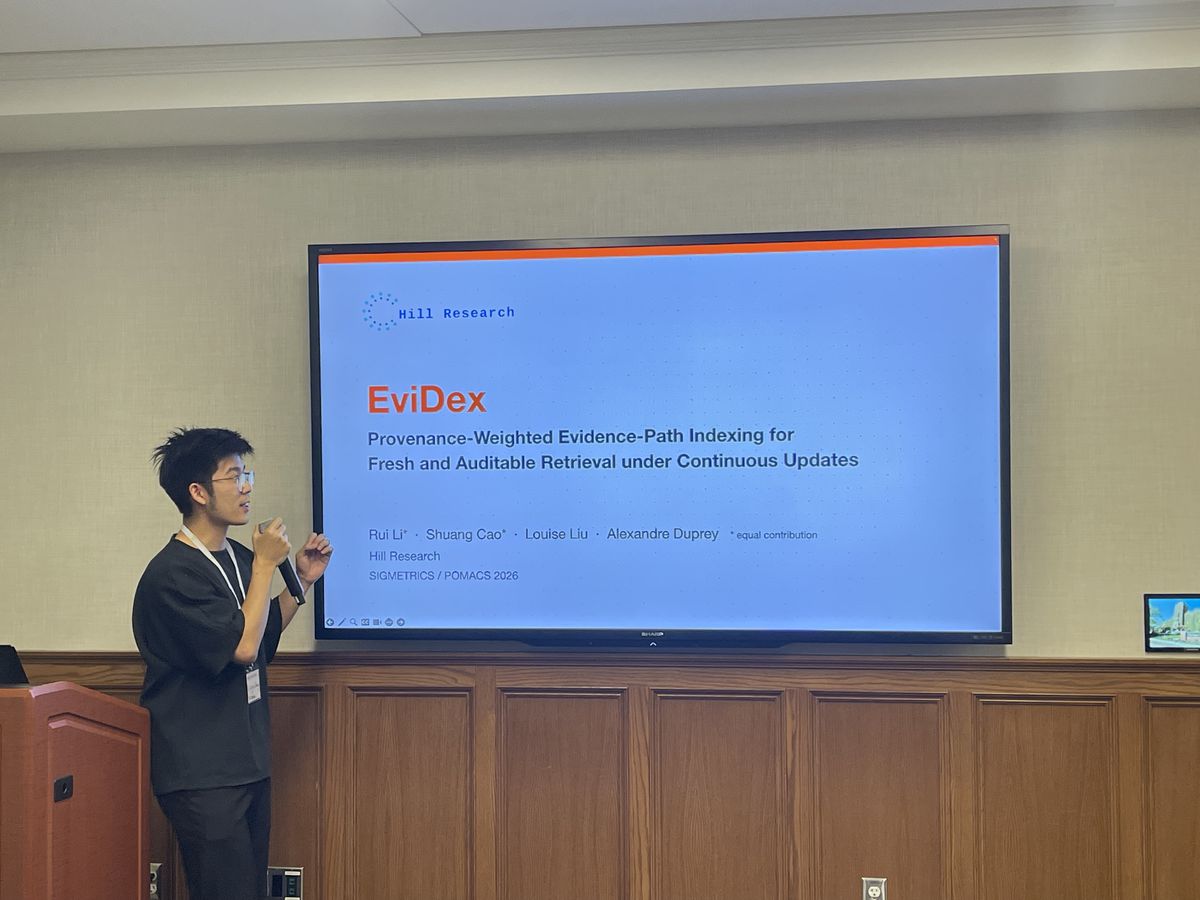
Hill Research’s Kai Zheng presented “EviDex: Provenance-Weighted Evidence-Path Indexing for Fresh and Auditable Retrieval under Continuous Updates” — by Rui Li, Shuang Cao, Ruihua Liu, and Alexandre Duprey — at ACM SIGMETRICS 2026 in Ann Arbor, Michigan. The talk ran in Session 2B, “Caching,” on Tuesday, June 9. The paper appears in Proceedings of the ACM on Measurement and Analysis of Computing Systems, Vol. 10, No. 2, Article 38.
About SIGMETRICS 2026
ACM SIGMETRICS is the premier venue for computer systems performance measurement, modeling, and analysis. The 2026 edition ran June 8–12 in Ann Arbor, Michigan.
This follows Hill Research’s five paper acceptances at ACL, SIGMETRICS, MLSys, and JAMIA announced in April. This is that work reaching the conference floor.
The Problem
Retrieval systems increasingly run over corpora that never stop changing — FDA labels, NCCN guidelines, runbooks, policies, product documentation. Most production pipelines cache intermediate results and refresh them on a schedule, which opens a window in which recent updates are invisible.
In a clinical setting that window is a safety problem rather than a performance one. A label is amended at one moment; a question that depends on the amendment arrives a few minutes later; a time-to-live cache serves the previous state until its next refresh boundary, and the retrieval layer gives no signal that it has done so.
The paper measures how often this actually bites. Query–update dependency turns out to be strongly intent-dependent: at a 15-minute horizon, 31.2% of time-sensitive clinical queries depend on an update committed within the window, against 8.4% of factoid queries. A single global TTL is therefore mistuned for whichever intent it was not set for.
The paper also shows the problem is structural, not an implementation defect. It proves a lower bound for any periodic-refresh policy: the staleness violation rate is at least pdep(τ)/2, where pdep(τ) is the probability that a query depends on an update committed within the refresh interval τ. Shrinking the interval narrows the stale window but inflates refresh cost and tail latency.
Indexing the Evidence Instead of Caching the Answer
EviDex avoids periodic answer refresh entirely. It continuously compacts a log-structured commit stream into intent-partitioned evidence-path buckets, so a new claim recomputes one bucket rather than triggering a global rebuild. Queries retrieve ranked multi-hop evidence paths that carry their provenance, which makes freshness a function of work — compaction plus lookup — rather than of a clock.
Three mechanisms carry the design: intent-partitioned buckets that amortize multi-hop evidence across repeated needs; admissible pruning that provably preserves exact top-B ranking while cutting candidate paths by 67.3%; and provenance-weighted scoring over authority, recency, and extractor confidence.
The evaluation covers two workloads — a 170,000-document clinical corpus drawn from FDA labels, NCCN, PMC-OA, and MIMIC-IV, and a Wikipedia revision stream of 2.84M revision events across 412K articles — against 12 baselines spanning streaming-aware caches, incremental indexing, and production near-real-time search.
Results:
- Evidence-set violation at 15 minutes, clinical: 1.3% (vs 2.4% for adaptive TTL, the strongest baseline)
- Evidence-set violation at 15 minutes, Wikipedia: 1.1% (vs 2.1%)
- Cost: $0.68 per 1k queries — 42% cheaper than adaptive TTL, at better freshness
- Pareto-optimal against all 12 baselines on both workloads
- Candidate paths pruned: 67.3%
- Lookup-service scaling: 1,856 queries/sec at 16 nodes and 10M documents, p99 latency 2.14s (lookup only, excluding generation)
- Clinical correctness: 0.884 on an 800-question safety stress test rated by five physicians
Relevance to TriClick: Regulated clinical work has two requirements that are usually treated separately — the evidence must be current, and a reviewer must be able to reconstruct which source, at which version, supported a given claim. EviDex treats them as the same requirement. Because every retrieved path carries its provenance rather than having it reattached afterwards, the audit trail is a property of how the answer was assembled. That is the discipline TriClick applies across its clinical workflows: an output a reviewer cannot trace back to a versioned source is not finished work.
Why It Matters
Freshness in retrieval is usually framed as a tuning problem — pick a shorter interval, accept the cost. The lower bound reframes it as a structural one: no periodic policy escapes the floor, so the fix has to change what is maintained rather than how often it is rebuilt. Reporting the lookup-service scaling separately from end-to-end results is part of the same posture, and it is the kind of claim that survives contact with a regulator.