
Hill Research at ACL 2026: Contract-Checked Editing for Verifier-Guided LLM Reasoning
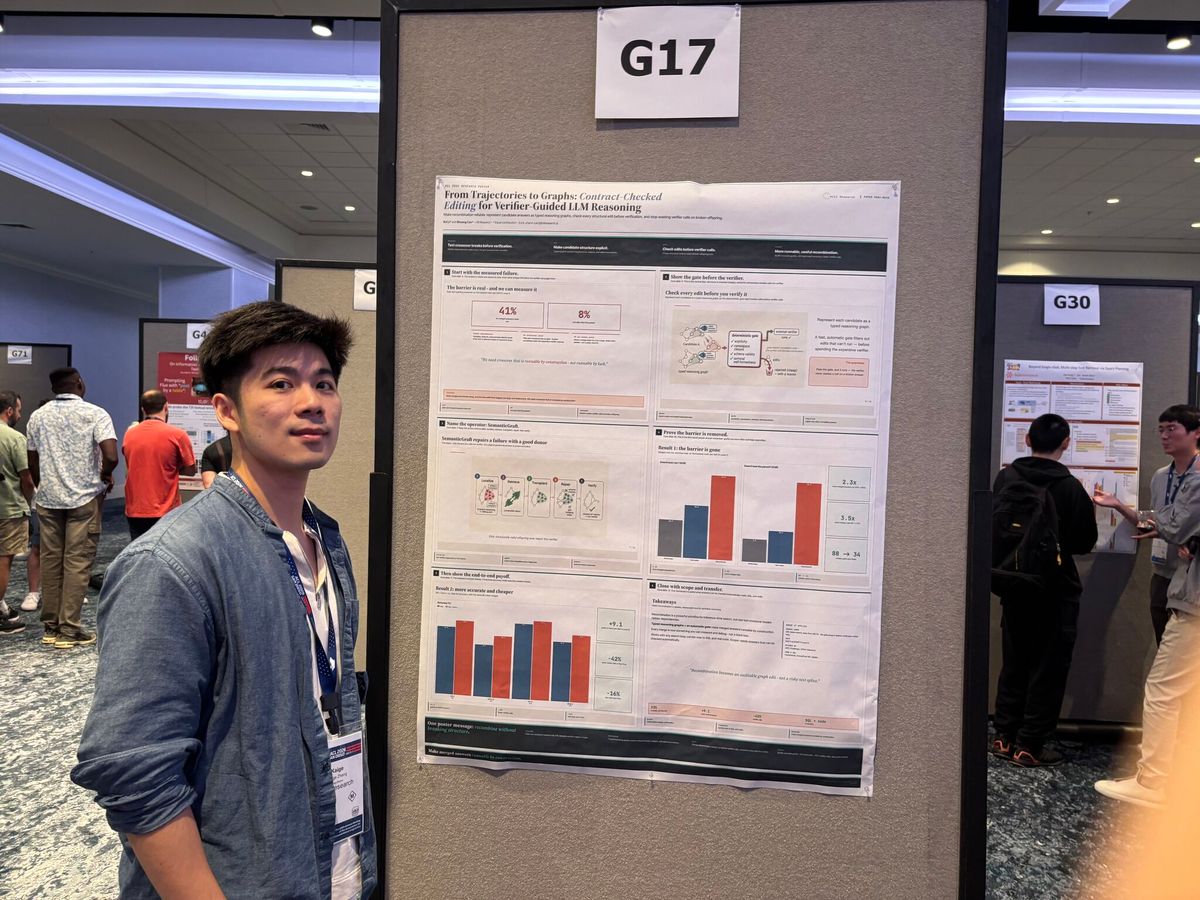
Hill Research’s Kai Zheng presented “From Trajectories to Graphs: Contract-Checked Editing for Verifier-Guided LLM Reasoning” — by Hill Research CTO Dr. Jack (Rui) Li and Shuang Cao — at the 64th Annual Meeting of the Association for Computational Linguistics (ACL 2026) in San Diego. The work appears as a main-conference long paper in Volume 1 of the proceedings.
About ACL 2026
ACL is the top venue in computational linguistics. The 2026 edition ran July 2–7 in San Diego, California — tutorials July 2, workshops July 3–4, and the main conference July 5–7.
This follows Hill Research’s five paper acceptances at ACL, SIGMETRICS, MLSys, and JAMIA announced in April. This is that work reaching the conference floor.
The Problem
Inference-time search can substantially improve LLM reasoning when a task admits deterministic verification. But existing methods largely refine a single trajectory, and lack a reliable way to compose partial solutions across candidates.
The obstacle is that what a solution depends on — variables, definitions, tool inputs and outputs, imports, schemas, answer formats — stays implicit in free-form text. Splice two candidates together naively and the result often does not run at all, burning an expensive verifier call before the system can judge whether the reasoning was sound.
Contract-Checked Graph Editing
The paper represents each candidate as an interface-typed reasoning DAG and validates every nontrivial edit with a deterministic structural gate — acyclicity, namespace closure, schema validity, terminal constraints — before invoking the verifier.
The division of labor is the point: the gate certifies runnability only, and emits auditable rejection reasons. Semantic correctness remains the verifier’s job alone.
Instantiated in Genetic Inference Search (GIS) with Qwen2.5-32B-Instruct under strictly matched 8K-token budgets:
Results:
- Verifier-runnable recombination: 41.2% → 92.8%
- Accuracy over rStar: +6.1 on MATH, +9.1 on MATH Level 5
- Verifier calls: 42% fewer
- Transfers across outer loops — beam, best-first, MCTS
- Text-to-SQL: +2.8 on Spider, outperforming execution-guided beam search
- Multi-file code generation: +9.2 on HumanEval-MF
Relevance to TriClick: In regulated workflows an AI system cannot simply produce plausible text. Outputs must be structurally valid, verifiable, auditable, and safe to hand to a downstream validation step. A gate that rejects unrunnable candidates cheaply — and explains why it rejected them — is the same discipline TriClick applies to statistical programming: catch what cannot possibly be right early, and spend the expensive check on what might be.
Why It Matters
The distance between a research result and a regulated product is verification infrastructure. Auditable rejection reasons are not a side effect here; they are what makes the method usable in a setting where a reviewer has to be able to ask why a candidate was discarded.