
Hill Research Co-Hosts Clinical AI Mastermind S2 at Johnson & Johnson
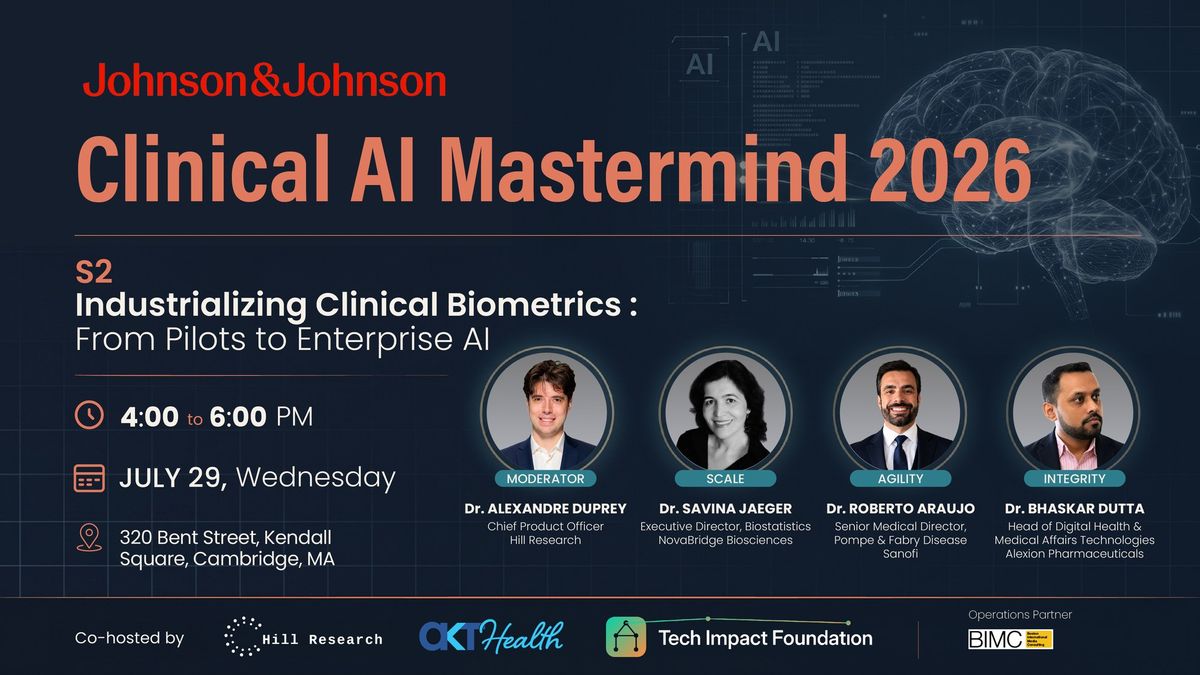
On July 29, 2026, Hill Research co-hosted Session 2 of the Clinical AI Mastermind 2026 at Johnson & Johnson in Cambridge. The topic: Industrializing Clinical Biometrics: From Pilots to Enterprise AI.
The Mastermind is a bimonthly, curated forum for senior pharma, biotech, regulatory, biometrics, and clinical AI leaders to compare notes on what is actually working — not vendor pitches, not polished demos. Session 2 was the second of four planned across the year, and it moved past model capability to a harder enterprise question: what operating system lets AI-assisted work become trusted clinical evidence?
📄 An Executive Insight Report will follow: Industrializing Clinical Biometrics: What the Room Found — the deep-dive analysis of what the room said before, during, and after the forum. It will publish here and go to everyone who attended.
Hosts
- Anchor host: Johnson & Johnson
- Co-hosts: Hill Research · AKT Health · Tech Impact Foundation
- Operations partner: Boston International Media Consulting (BIMC)
The Curator’s Statement
“Clinical biometrics is no longer primarily a productivity problem. It is an enterprise AI problem.”
The conversation was framed around three pillars: Scale, Agility, and Integrity.
Before the session, every guest was asked one question: where does clinical biometrics most struggle to move from individual AI pilots to enterprise scale, and what has your organization not yet solved? Twenty-three answered. Their words went up on the wall of the room, in their own wording, grouped into five themes. Not one reply said the problem had been handled.
Panel
- Moderator — Dr. Alexandre Duprey, Co-Founder and Chief Product Officer, Hill Research
- Scale — Dr. Savina Jaeger, Executive Director, Biostatistics, NovaBridge Biosciences
- Agility — Dr. Roberto Araujo, Senior Medical Director, Pompe & Fabry Disease, Sanofi
- Integrity — Dr. Bhaskar Dutta, Head of Digital Health and Medical Affairs Technologies, Alexion Pharmaceuticals
- Welcome remarks — Dr. Charmaine Demanuele, VP & Head of R&D Data Science & Digital Health for Neuroscience, Johnson & Johnson
- Co-host remarks — Louise Liu, Chief Executive Officer, Hill Research
- Co-producer — David Hall
Hill Research’s Take
Hill Research Chief Executive Officer Louise Liu opened the co-host remarks with the question the afternoon kept returning to:
“Do we really trust AI during the clinical trials?”
The room’s answer was conditional.
AI can create more drafts, more code, more specifications, more analyses, more summaries. But greater production does not automatically create evidence that a statistician, clinician, regulator, or auditor can trust. That requires explicit data rights, provenance, versioning, scientific checks, qualified review, decision authority, and an audit trail.
This is the operating problem Hill Research is addressing with TriClick: connecting protocol intent, data standards, statistical specifications, programming, review, and traceability so that AI supports clinical accountability rather than bypassing it.
Lines That Stuck
Dr. Savina Jaeger (NovaBridge Biosciences) — on scale:
“What we can scale with AI is standardized production. What doesn’t is the judgment that decides whether the output is right.”
“A green check is necessary but not sufficient.”
“You cannot hold a model accountable. You hold a human accountable.”
Dr. Roberto Araujo (Sanofi) — on agility:
“The limit on adaptive design is governance rather than technology — and the answer is timing.”
“Patient safety and evidence integrity remain primary objectives.”
Dr. Bhaskar Dutta (Alexion) — on integrity:
“Show me how you got the results.”
What the Room Worked Through
The keynotes and the panel applied the three pillars to practical enterprise questions:
- How should an organization start when its data is not yet standardized or fully traceable?
- Can a twelve-person biotech meet the same evidence standard as a global pharmaceutical company?
- How should consent and permitted use travel with long-running registry data?
- What does “human in the loop” mean at different levels of clinical risk?
- How do domain experts learn to use AI while remaining able to defend the workflow to an auditor?
- If AI absorbs junior production work, where will the next generation acquire expert judgment?
- What happens to enterprise economics when pilot-scale model usage becomes production-scale usage?
The room did not prescribe one control pattern for every use case. It argued for a risk-based model: define the decision, the stakes, the model’s maturity, the qualifications of the reviewer, and the point at which independent reproduction or escalation is required.
The Underlying Theme
Across scale, agility, and integrity, the industrialization problem is no longer whether AI can produce a clinical artifact.
It is whether every important artifact can arrive with:
- its source and permitted use;
- its transformation and model history;
- its scientific and technical checks;
- its reviewer and decision authority; and
- a path that an independent person can reconstruct.
The model may generate the work. The operating system determines whether the work can become evidence.
AI can scale production. Only an accountable operating system can scale evidence.
Thanks
Thank you to Dr. Charmaine Demanuele, Angellica White, and the Johnson & Johnson team for hosting; to Hill Research, AKT Health, and Tech Impact Foundation as co-hosts; to BIMC as operations partner; to David Hall for co-producing; to Dr. Savina Jaeger, Dr. Roberto Araujo, and Dr. Bhaskar Dutta for the three keynotes; to Dr. Alexandre Duprey for moderating; and to every guest who came out in heavy rain and challenged the panel with an implementation question.
Session 3 is on October 7: The Architectural Shifts in Phase Three. The series moves upstream, from what happens after a trial is designed to the decisions made before the first patient enrolls.
Learn More
- Clinical AI Mastermind S1 — The Submission Last-Mile
- Executive Insight Report from S1: What the Room Found
- For partnership inquiries, contact: info@hillresearch.ai